
Resolution Enhancement on the IC101 and I404 Electrometers
How IC101 and I404 charge electrometers raise effective ADC resolution from 16 to 20 bits with integration and read averaging.
Resolution Enhancement
The IC101 and I404 charge measurement electrometers let you specify resolution settings from 16 to 20 bits. The method combines two averaging strategies. For how charge integrators differ from F-series current converters, see Choosing F or I Devices for Current Measurement. Related high-density integrators such as the I128, I6400, and IX256 cover larger channel counts; this note is specific to the IC101 / I404 resolution controls.
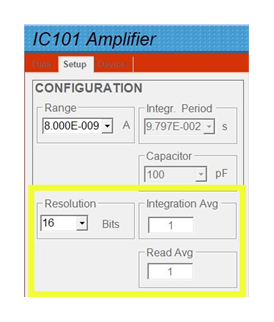
In the device Setup configuration, Resolution (bits) drives the Integration Avg and Read Avg values. So long as there is random variation in the signal, averaging increases the effective resolution of each reported measurement. Averaging two analog-to-digital conversions raises the native 16-bit resolution to 17 bits, four conversions give 18 bits, and so on up to sixteen conversions for 20 bits.
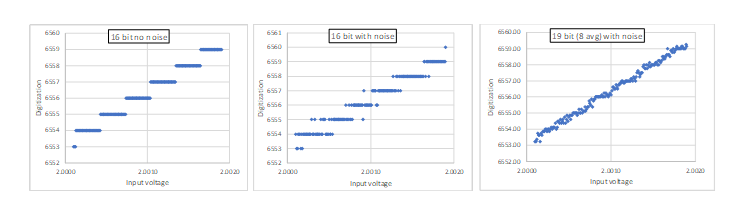
The plots above simulate an analog voltage changing over a small fraction of a 16-bit ADC range. With no noise (physically impossible), the ADC output jumps discontinuously when the signal reaches the next bit threshold. With noise, transitions blur, but digital resolution stays the same. With eight repeat readings per data point in the presence of noise, the gaps fill and effective resolution increases (19 bit example shown).
Integration Average and Read Average
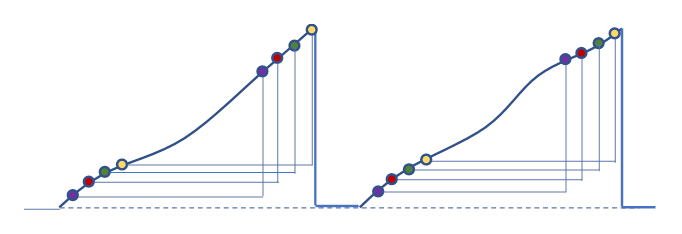
The two strategies for repeat readings are integration average and read average. Integration average combines results from multiple integrations as a rolling average. Read average takes more than one start and stop conversion during each integration cycle.
The illustration shows charge-integrator output over two integration cycles when four ADC pairs are taken per charge integration. Each start/stop ADC pair is separated by the known fixed integration time. Results from two integrations are then combined to give eight values, averaged for an effective resolution of 19 bits. The IC101 or I404 selects the optimum combination of the two strategies according to the selected current range.
Noise Reduction
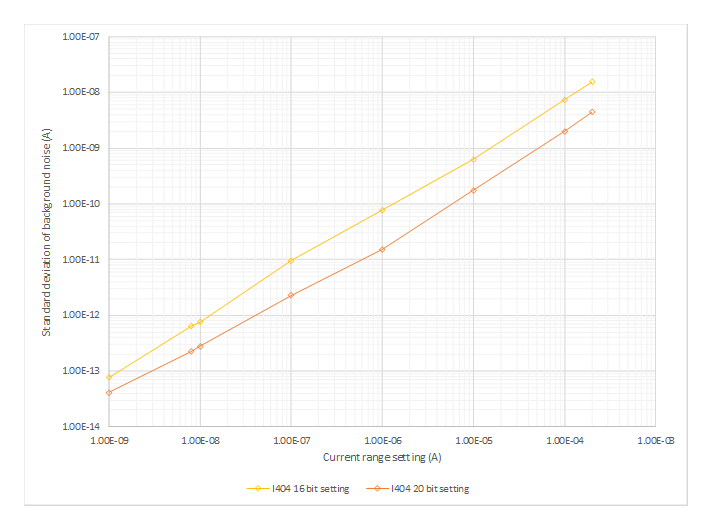
Because resolution enhancement uses averaging, it also reduces random noise in the data. The plot shows measured standard deviation for an I404 input connected to a miniature ionization chamber via coaxial cable across the standard current range selections. The 20-bit setting shows lower noise for all range settings.
For calibration practices on these electrometers, see Calibration of Current and Charge Measuring Devices. Cabling guidance is under Accessories. Contact us with application questions.