
Selecting a Transmission Ionization Chamber for Particle Therapy Dosimetry
Choose Pyramid transmission ionization chambers for particle therapy dose delivery: area, patterning, gaps, WET, and model comparison.
Types of Ionization Chamber for Particle Therapy
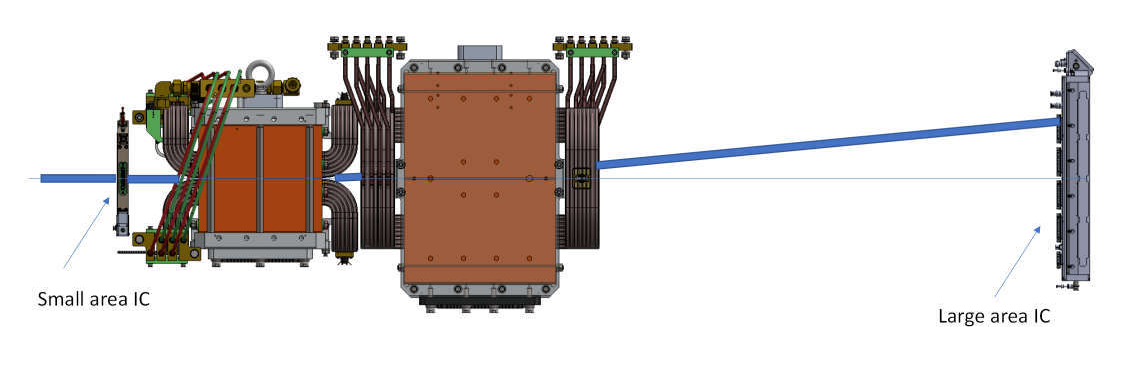
Ionization chambers are well-established radiation detectors: reliable, radiation-hard, simple to use, linear over a useful range, and available in many sizes and configurations. In a particle therapy system they appear in the dose delivery nozzle, in transfer-line beam diagnostics, and for quality assurance in the treatment room.
This note focuses on parallel-plate transmission chambers integrated into medical devices that deliver charged-particle beams (protons, carbon ions, and related therapy beams), and summarizes the design features that matter for dose delivery control on Pyramid products.
Dose Delivery Control in the Nozzle
The following considerations apply to ionization chambers in a dose delivery nozzle.
Sensitive Area
Chambers downstream of scanning magnets or lateral scattering need enough area for the maximum deflection or useful limits of the beam. Chambers upstream of scanning or scattering, or used for research, can use a smaller area.
Electrode Patterning
For whole-beam current, the readout electrode can be a continuous plane (integral or dose plane). For position and shape, the electrode must be patterned. Common patterns are strips, pixels, or quadrants. Patterned electrodes can also yield integral information by summing channels in software, but that usually costs signal-to-noise versus a dedicated integral electrode and electronics channel.
A quadrant pattern is excellent for beam centering in both axes, but does not directly report offset magnitude or shape. A strip array gives a one-dimensional projection of the beam profile, so two orthogonal arrays are needed for both transverse axes. In a vacuum transfer line, transport is usually independent in the two axes, so one projection can be enough. A pixel array gives true two-dimensional visualization (including rotated or anomalous shapes) at the cost of many more readout channels.
Position Resolution
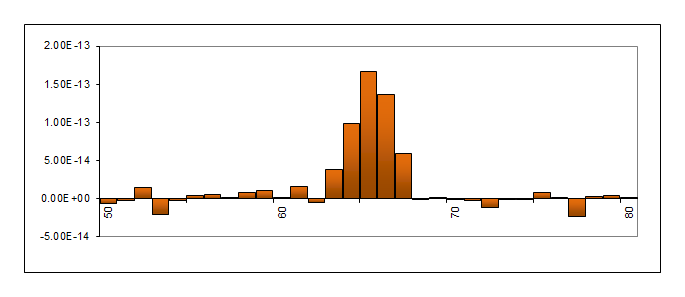
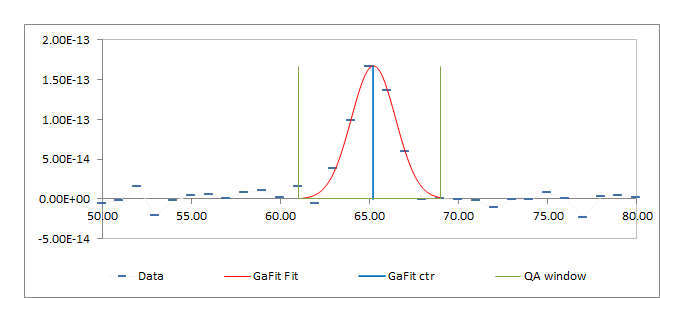
Centroid and width resolution depend on strip or pixel pitch. Pitch should put useful signal from the smallest beam spot on three or more channels so a curve can be fitted. Fitted resolution is typically about one tenth of the strip pitch or better. The plots above show fitting a peak with a Gaussian sigma of one strip pitch.
Number of Active Volumes
The minimum parallel-plate assembly is one active gap between a readout electrode and a bias electrode, with a uniform gap for a uniform field. For reliability, operate in a well-controlled gas volume inside an electrically screened enclosure, with thin entry and exit windows so the beam can pass through.
Multiple gaps in one housing pack more functions into less z-space along the beampath. Pyramid models range from a single-gap position chamber such as the PX-3, through two-gap dose-and-position designs such as the IC64-13, to multi-gap assemblies such as the IC128-25 family with dual-gap dose and orthogonal position planes. Electrodes and gaps in one enclosure can be made electrically independent for redundant, safety-critical therapy readings. A dual-gap integral configuration can also combine two gaps onto one readout for twice the signal while keeping small individual gaps.
Gain
Transmission parallel-plate gain is proportional to electrode gap, other things equal. Larger gaps suit low beam currents. At higher currents (flash therapy or pulsed-accelerator peaks), recombination and field suppression cause non-linearity. Small gaps (as low as 1 mm on Pyramid high-current models) with high bias mitigate that.
Water Equivalent Thickness
Nozzle chambers should disturb the beam as little as practicable. Pyramid dosimetry chambers use thin tensioned Kapton films with fine gold or aluminum coatings. Total beam effect is expressed as water equivalent thickness (WET). Pyramid dosimetry chambers typically span about 255 µm down to below 100 µm WET.
Gas Filling
Air is typical for particle therapy nozzles. Exclude water vapor, which can change gain and degrade connections. Temperature and pressure of the fill gas must be known for density corrections. Most Pyramid chambers include desiccant and built-in sensors for temperature, pressure, and humidity. Nitrogen or Ar/CO2 can help for specific high-current work. Dosimetry chambers include gas flow and return ports for compatible fill gases.
External Dimensions
Space in the nozzle is limited, especially along z. Pyramid chambers are packaged tightly, and many models put multiple active gaps in one housing so fewer assemblies are required.
Summary of Dose Delivery Models
Pyramid ionization chambers cover sensing areas from about 25 × 25 cm down to 1.9 cm diameter, and gaps from 10 mm down to 1 mm. Nearly all models use gold-coated Kapton readout electrodes, environmental sensors, desiccant, and bias-voltage loopback. New configurations are added regularly.
| Model | Role |
|---|---|
| IC128-25 (LC / VH / LC-2I) | Widely used downstream of scan magnets for dose and position; dual-gap integral plus orthogonal strips. Often used in pairs for redundant dose and position. LC-2I adds a second independent integral dose section for IEC 60601-2-64 dose redundancy in one assembly. |
| IC64-16 (SG) | Medium area, small gaps for higher flash-therapy currents. |
| IC64-13 (+ SG) | Medium area with integral dose and one position axis; pair for redundant dose and orthogonal position. SG variant for higher currents. |
| IC64-6 | Small area, very small gaps and fine pitch for flash therapy research. |
| IC32-6 | Small chamber for position upstream of scan magnets and research. |
| IC16-5 | Compact low-cost position readout with aluminized electrodes. |
| PX-3 (3.8 / 2.5) | Small pixelated chamber for 2D position upstream of scan magnets; finer pixels on the 2.5 variant. |
| QIC-2S | Miniature quadrant chamber for narrow pencil beams in tight spaces. |
| QIC-6E | Low-scattering quadrant chamber for ophthalmic work and low-energy beams (for example protons below about 70 MeV). |
Larger modern peers such as the IC256-42 and IC256-45 extend the same transmission-chamber family for denser readout.
Key Parameters
Gain and WET below are Monte Carlo values for monoenergetic protons in air at STP (a common reference for comparing models). Use them comparatively, not as a substitute for water-phantom calibration on a specific accelerator or ion species. All high-voltage connectors are SHV.
Feature codes: Au gold electrode coatings; BVL bias-voltage loopback; Env built-in temperature, pressure, and humidity sensors; Des built-in desiccant; SG small-gap high-current design.
Geometry and Packaging
| Model | Area | Configuration (pitch mm) | Gaps (mm) | Length (mm) | Features / connectors |
|---|---|---|---|---|---|
| IC128-25 LC | 25 × 25 | Dual-gap integral 128 X strips 2.0 128 Y strips 2.0 |
5.0 / 5.0 7.0 7.0 |
50.7 | Au, 2× BVL, 2× Env, Des 0B.304, 8× HD44 |
| IC128-25 VH | 25 × 25 | Dual-gap integral 128 X strips 2.0 128 Y strips 2.0 |
5.0 / 5.0 7.0 7.0 |
50.7 | Au, BVL, 2× Env, Des BNC, 4× VHDCI68 |
| IC128-25 LC-2I | 25 × 25 | Dual-gap integral 128 X strips 2.0 128 Y strips 2.0 Dual-gap integral |
5.0 / 5.0 7.0 7.0 5.0 / 5.0 |
55.7 | Au, 2× BVL, 2× Env, Des 2× 0B.304, 8× HD44 |
| IC64-16 SG | 16 × 16 | Dual-gap integral 64 X strips 2.5 64 Y strips 2.5 |
1.0 / 1.0 3.0 3.0 |
50.7 | Au, BVL, 2× Env, Des BNC, 2× VHDCI68 |
| IC64-13 | 12.8 × 12.8 | Integral 64 W strips 2.0 |
3.8 3.8 |
28.4 | Au, BVL, 2× Env, Des 0B.304, 2× HD44 |
| IC64-13 SG | 12.8 × 12.8 | Integral 64 W strips 2.0 |
1.0 6.6 |
28.4 | Au, SG, BVL, 2× Env, Des 0B.304, 2× HD44 |
| IC64-6 | 6.4 × 6.4 | Integral 64 X strips 1.0 64 Y strips 1.0 |
1.0 3.0 3.0 |
37.0 | Au, SG, BVL, Env, Des 0B.304, 2× VHDCI68 |
| IC32-6 | 6.4 × 6.4 | 32 X strips 2.0 32 Y strips 2.0 |
3.0 3.0 |
37.0 | Au, BVL, Env, Des 0B.304, 2× HD44 |
| IC16-5 | 4.8 × 4.8 | 16 X strips 3.0 16 Y strips 3.0 |
3.0 3.0 |
37.0 | Env, Des 2× D25 |
| PX-3 3.8 | 4.2 dia | 120 pixels 3.8 sq | 5.0 | 14.6 | Au, BVL, Env, Des 2× VHDCI68 |
| PX-3 2.5 | 2.8 dia | 120 pixels 2.5 sq | 5.0 | 14.6 | Au, BVL, Env, Des 2× VHDCI68 |
| QIC-2S | 1.9 dia | Quadrant | 3.2 | 7.6 | Des 0B.304 |
| QIC-6E | 6.0 dia | Quadrant | 3.6 | 31.4 | Au, BVL, Env, Des 4× Lemo 00.250 |
Gain and WET
Proton reference gains at 70 / 150 / 230 MeV. Multi-gap models list each distinct plane once (matching X/Y strip planes are not repeated).
| Model | Gain (70 / 150 / 230 MeV p+) | WET (µm) |
|---|---|---|
| IC128-25 LC | Integral 294 / 162 / 122; strips 210 / 115 / 88 | 195 |
| IC128-25 VH | Integral 294 / 162 / 121; strips 210 / 115 / 88 | 170 |
| IC128-25 LC-2I | Integral 298 / 167 / 126; strips 211 / 118 / 89; 2nd integral 298 / 167 / 126 | 255 |
| IC64-16 SG | Integral 57 / 31 / 24; strips 87 / 49 / 36 | 130 |
| IC64-13 | Integral 111 / 61 / 47; W strips 113 / 62 / 47 | 140 |
| IC64-13 SG | Integral 29 / 16 / 12; W strips 197 / 108 / 80 | 140 |
| IC64-6 | Integral 29 / 16 / 12; strips 90 / 51 / 37 | 200 |
| IC32-6 | 88 / 49 / 36 | 150 |
| IC16-5 | 88 / 49 / 37 | 150 |
| PX-3 3.8 | 145 / 81 / 60 | 105 |
| PX-3 2.5 | 145 / 81 / 60 | 105 |
| QIC-2S | 93 / 51 / 38 | 70 |
| QIC-6E | 104 / 57 / 44 | 65 |
Using Ionization Chambers for Dosimetry
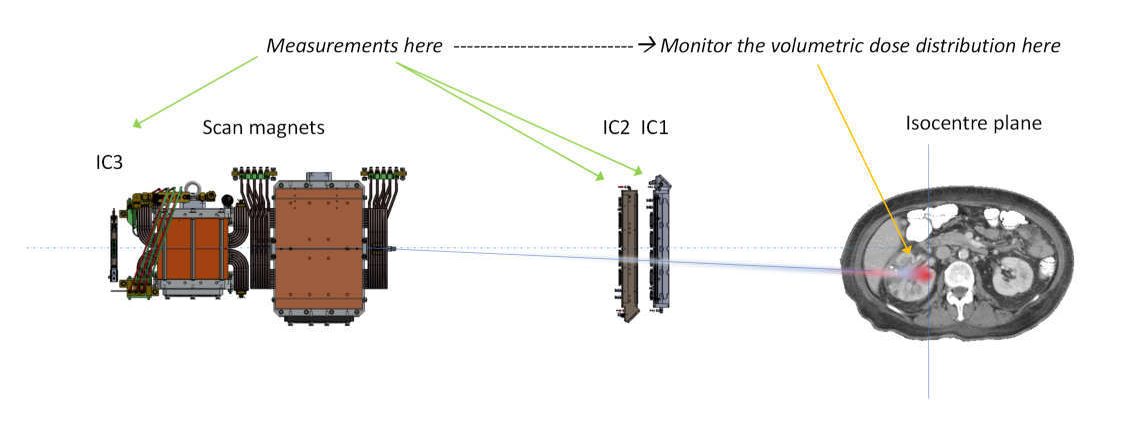
Therapeutic delivery is defined on an isocentre plane in the patient. Most treatments use spot scanning. QA can place diagnostic detectors at that plane in a water or water-equivalent phantom, but not during patient treatment. Instead, charge and position on nozzle ionization chambers, plus beam energy, stand in for the patient dose distribution.
Treatment planning relates those measurements to patient dose from water-phantom maps, and QA confirms delivery maps against expected distributions. Chamber requirements for this job include:
- Stable, linear performance over the expected beam-current range
- Sensitive area that captures the beam in all relevant settings at the chosen location
- Low WET so small spots remain deliverable
- Position resolution matched to the smallest spots
- Gain that balances signal-to-noise against recombination at high current
- Radiation hardness, reliability, and compact packaging
For current and charge readout electronics paired with these detectors, see electrometers and Choosing F or I Devices for Current Measurement. Contact us for nozzle layout help, or browse related notes on Support.